Doing Everything Well (or Poorly!)
A wildly speculative treatise on the downfall of Jack-of-all-trades systems
Author: Dave Cline
Posted: 12/26/2025
Intro
I’ve been thinking a lot about trade-offs in software lately. In particular, when should a SaaS company stop adding new features and focus on perfecting the ones they already have? How many things should a single SaaS product be doing? And in fact, how many things can a SaaS company be doing if they want to do everything well?
In the past, SaaS companies have largely chosen one or the other: a decent number of quality features, or a large number of half-baked features.
But I believe that is about to change because of two big shifts in tech: the rise of orchestration platforms (e.g.make.com), and the sudden appearance of AI agents. This blog post will walk you through my somewhat-educated guess as to how these two major players in tech will be rapidly narrowing the focus and increasing the quality of SaaS tools. I’ll start with some general thoughts on how companies currently choose to structure their offerings, and then will get into the good stuff where I take a shot at predicting the near future.
Zapier is another good example of an orchestration platform that has been quietly reshaping how SaaS tools connect.
Since Swift Missive is a high-quality and appropriately balanced email-marketing platform, I'll also be making a lot of references to the email-marketing industry.
Structuring SaaS products
There are a TON of ways to structure a marketing SaaS product. This is really because there are a TON of different ways for marketers to do their jobs effectively. Some marketers just want to send some emails, others want to have AI research the people they are sending emails to, or to use a CRM for their contacts so that sales and marketing can use the same product. The list goes on.
Here are some example diagrams just to show you some of the different shapes the products can take. Every SaaS company will have this kind of internal diagram somewhere in their documentation folders.
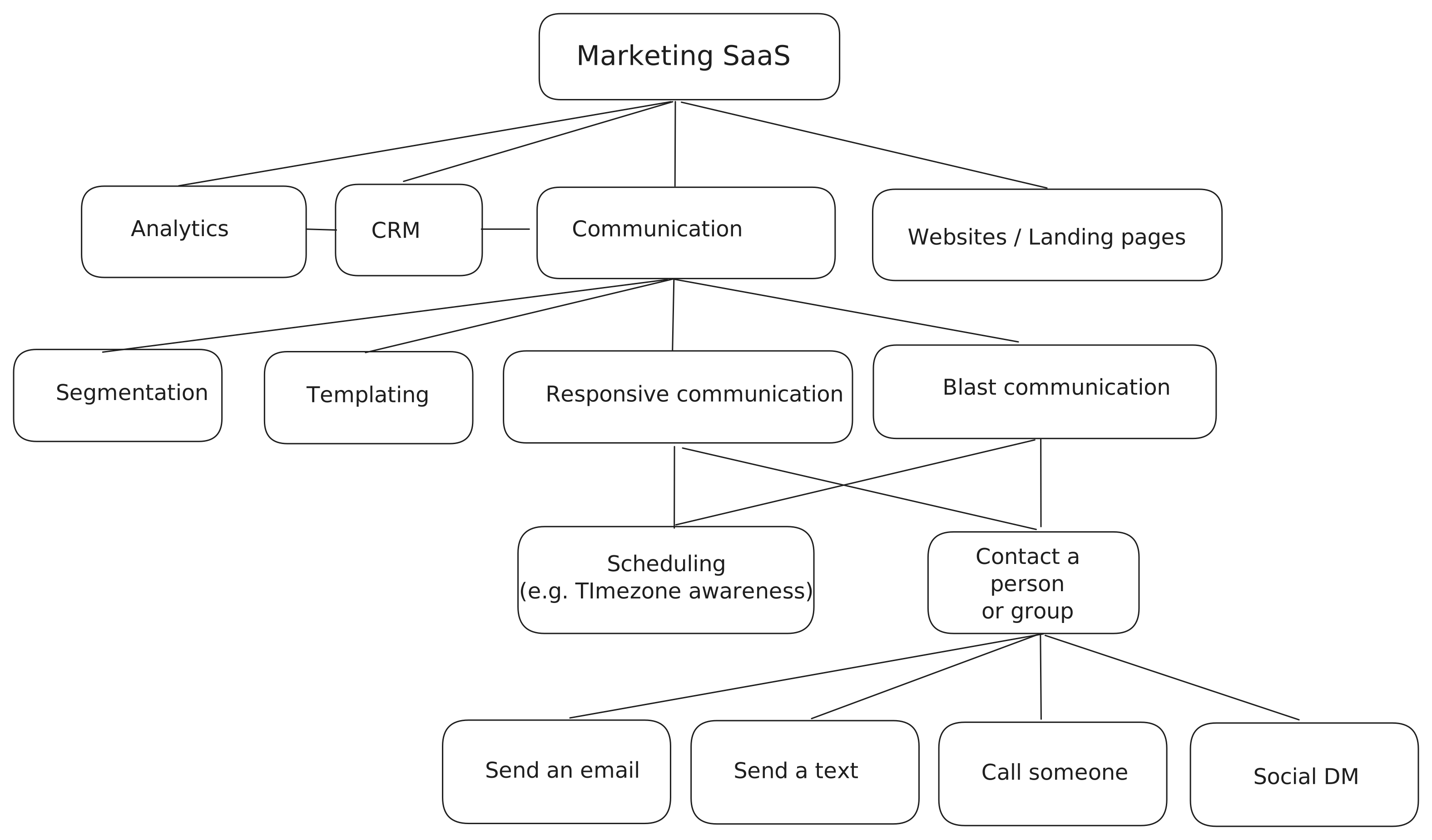
An all-in-one SaaS marketing product
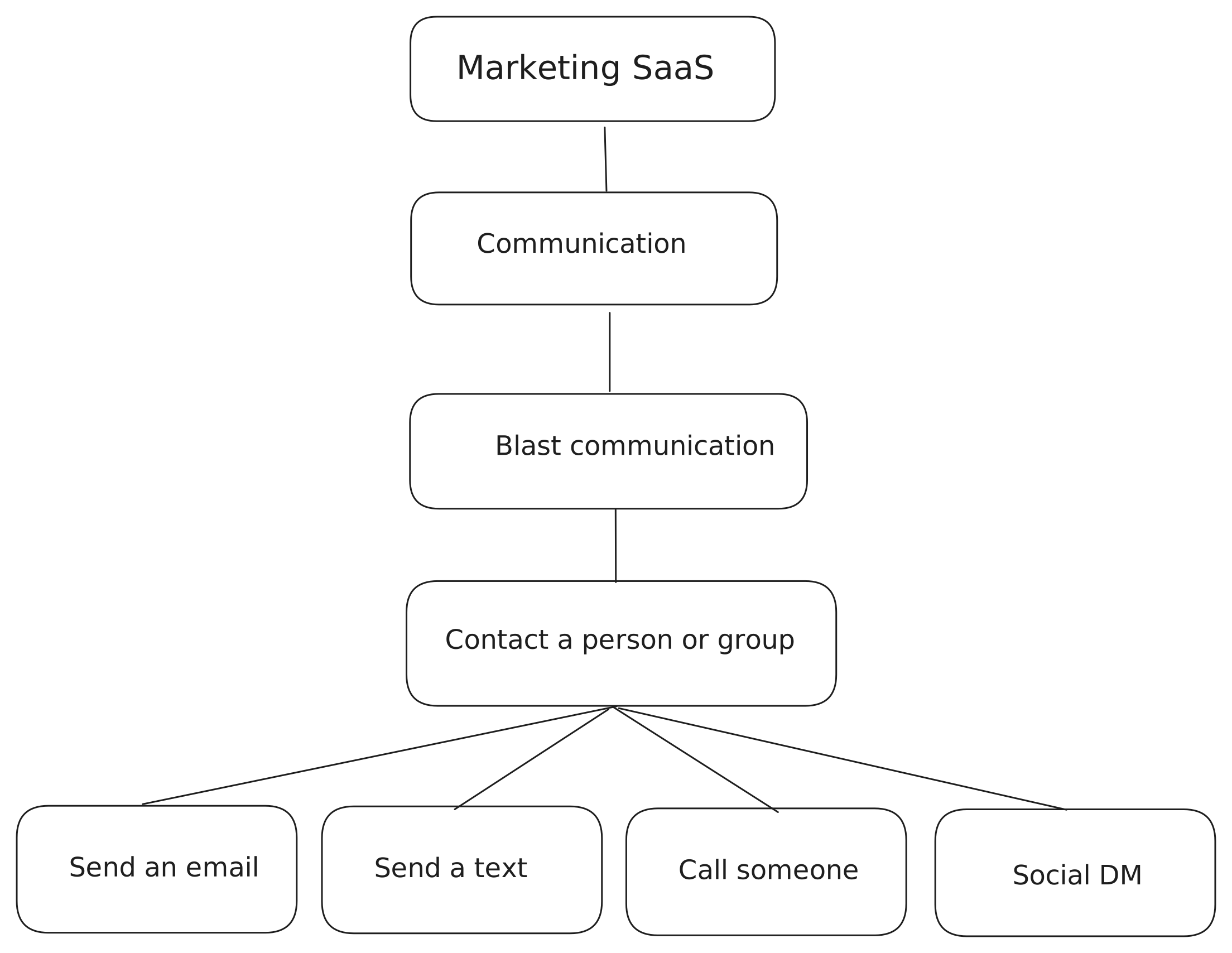
A blast-only SaaS marketing product
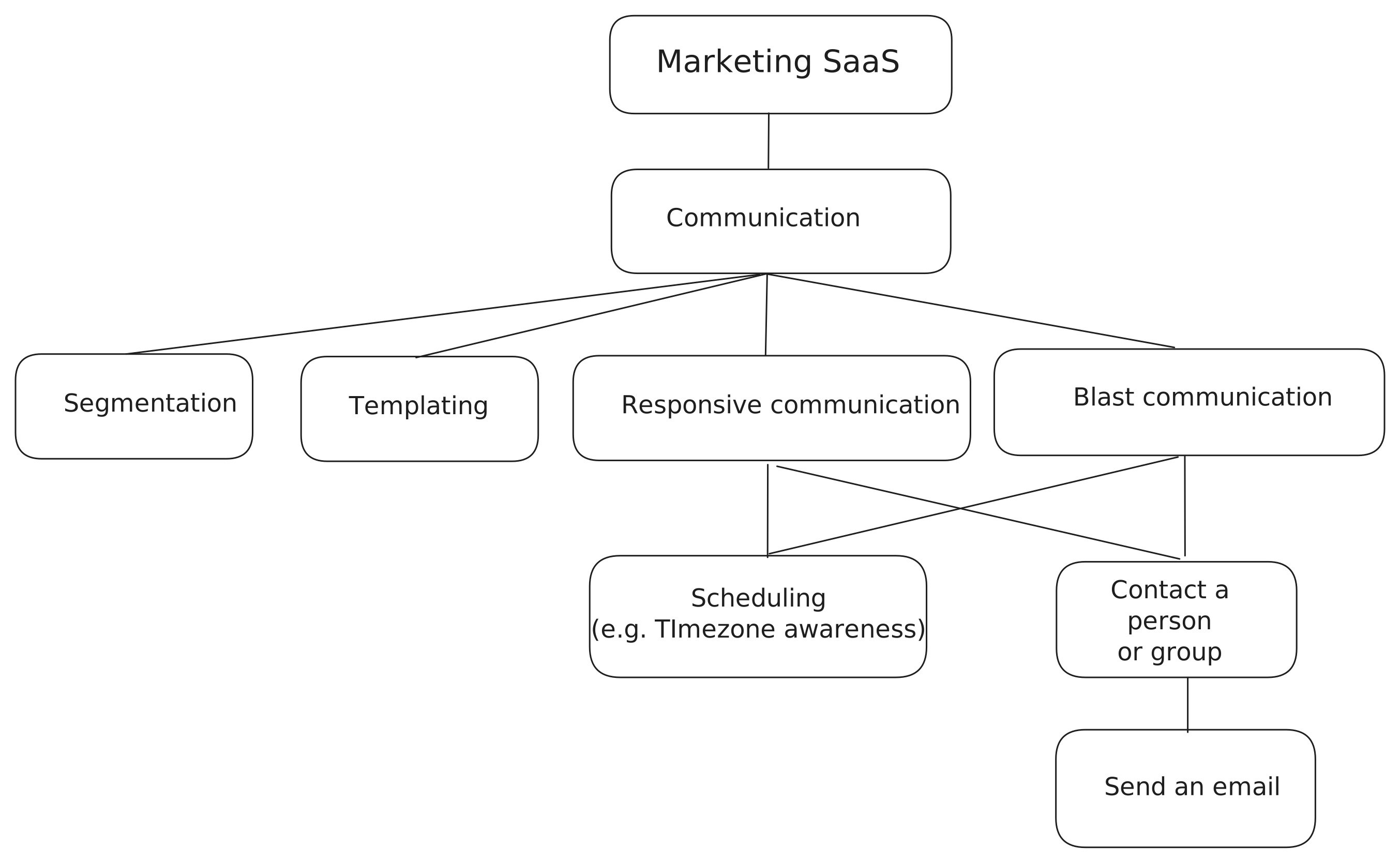
An email-centric SaaS marketing product
How does a company pick a shape?
A SaaS company usually starts pretty small, offering just a few critical features. Then it adds a few more features as it finds more customers or more money, or finds different areas of the market it can capture, and then it rinses and repeats over and over as it grows.
Eventually, after growing like this for some time and having finished up its original roadmap, the company hits an inflection point where it has to decide exactly what its future product is. Leadership starts to think about all sorts of things: there are customers who need a CRM as well as an email-marketing tool, should we just add a CRM to our email-marketing tool? Should we build a CRM tool ourselves or just buy a company and duct-tape it to the side of our company? What do we want to offer, and how good do we want it to be?
Some companies—like Swift Missive!—hit this inflection point and figure out what they can offer that helps as many people as possible without sacrificing quality. But unfortunately those companies are rare. Most companies just ask themselves this: will people pay us more to add something to our product than we will spend to deliver it to them? If the answer is yes, they add it in. If it’s no, they don’t. Quality is generally not a consideration at all.
Finding the right wrong balance
The simple "is this profitable" calculation that most companies use is why so many of them end up doing too many things at once, and is why we have products like:
- Website-Email-CRM-Autodialer-Marketing Tools
- Sales-Funnel-Lead-Scoring-Email-Marketing Tools
- Storefront-Email-Ads-Notification-Marketing Tools
- Invoicing-Calendar-Website-SMS-Marketing Tools
Now I can’t say for sure what the exact best number of features is, but I can say that if you are trying to dothat many things at once, you’re probably not doing them very well. How do you even describe something that has so many names? In the immortal (and paraphrased) words of Courtney Love as she roasts some of her similarly over-titled contemporaries:
“Worker-waitress-model-actress... oh, just go nameless.
That is not to say that definitional ambiguity completely removes the value of a product. In fact, there are even some advantages to systems like that. Namely: when a user really does want a CRM, a storefront, a website, and a marketing tool, but they don’t need any of them to actually be all that good, then they'll probably pay a lower price and have a simpler time getting organized when everything they need is in one place.
However, changes in tech are starting to erase those advantages. In fact (since I promised wild speculation in this post), I will go further and say that those same changes in tech are not only going to erase those advantages but are going to pressure all SaaS companies in the future into developing higher quality, single-purpose (and/or "fewer-purpose") tools.
Hit the road Jack (of all trades!)
If we agree that simple convenience is the main driving force behind the adoption of all-in-one systems, it stands to reason that all-in-one systems are going to be extinct if similar but more convenient systems become available. Especially if the more-convenient things are also higher quality. So it is really just a question of if/when something like that is available, and then we can say goodbye to all-in-one systems.
And guess what? As it turns out, that is actually what we are already starting to see via orchestration frameworks like Make.com, and to an even greater degree via AI Agents. Let’s take a look at how these tools get their users closer to quality, purpose-built tools, while also allowing them to manage all of their tools in one place.
Orchestration frameworks
Orchestration frameworks likeMake.comoffer a way to glue multiple different apps together. For instance, you can set up a workflow to automatically sync leads from Google Forms to Google Sheets, send an email via Swift Missive, trigger an AI search for the customer, and then use the search results to enrich your Swift Missive contact data for more personalized emails.
Even if some companies do offer all of those things in one system, i.e. an Excel-email-enricher product, it again starts to seem unlikely that those single systems are doing all of those things very well; let alone doing Excel-like stuff as well as Google Sheets, emails as well as Swift Missive, and AI searches as well as the current AI searcher products out there. And even if that were true, then I can at least say with confidence that there is no single system on the planet that matches the quality and breadth of things that are doable by connecting ALL of the1,000s of apps on Make.cominto one super-system.
AI Agents
Make.com goes a long way to connect purpose-built systems together via automation and data-sharing, but for parts of a product that can’t be fully automated it still requires you to log into different tools to manage each part of your super-system. AI Agents—whether they will be hosted on Make.com or hosted on everyone’s individual operating systems—are starting to close that gap.
The key thing to understand about AI Agents right now is how theModel Context Protocol (MCP)is supercharging their ability to use the web. Via MCP, AI Agents can now do things like downloading recent submissions to your lead forms, then pushing any changes it finds up to Google Sheets, Swift Missive, and a purpose-built AI lead-enrichment app. When it is done collaborating with the AI enrichment app, it can then push any information they found together up to Swift Missive so you will have more personalized emails. Basically, through reasoning and MCP access, AI Agents can do anything on the web that you can do in addition to everything that orchestration frameworks can do, with minimal oversight and even despite ambiguous instructions.
Pretty awesome, huh? So why not just use only AI Agents? Well, it turns out that (at least currently) there are some issues with using them by themselves at scale.
The problem with (and solution to) using just AI Agents
While AI can already work this way across large swathes of the web, it is (at least currently) extremely expensive to use to process thousands or millions of data points. Further, there is not currently a popularly available and free AI Agent interface that will allow you to connect to all the different MCP servers that are popping up all over the web. For now, though, there is a combo solution that will give you the best of both worlds.
By using AI Agents to create Make.com workflows, we rely on orchestration systems to do the work of automating data-sharing between all the apps we care about, without having to create any of those workflows by ourselves. That way we are able to quickly and cheaply share thousands or millions of events between systems. Then for one-off requests like status reports, we can let the AI agent do the work of querying the disparate parts of our super-system for us and then combining the results into one summarized report.
Examples of using Make.com and AI Agents together
Here are a couple of example scenarios of how orchestration layers and AI Agents can be used together in the future, via an AI Agent chat interface.
Scenario 1: Status report!
- User:"What is the status of my marketing campaigns?"
- Agent: "Checking!"
- Agent checks Make.com MCP server to examine connections.
- Agent finds a Swift Missive connection, and a Google Ads connection.
- Agent queries its (speculative) internal password storage.
- Logs into both accounts, pulls stats, summarizes them.
- Agent: "You’ve sent 30,000 emails and shown 5,000 ads. You received 8,000 clicks."
Scenario 2: Customer support automation please!
- User: "When our support team receives an email, I want to create a support ticket automatically."
- Agent: "I’m on it!"
- Agent checks Make.com MCP server to examine apps.
- Agent uses the Make.com MCP server to create a new automated workflow that connects Gmail and Jira.
- Agent uses Swift Missive to send a test email to Gmail.
- Agent checks the workflow stats in Make.com to see that the connection worked.
- Agent: "All set, tested and working!"
Conclusion
I hope this has been an entertaining read that helped some of you learn about trends in the tech industry, including orchestration layers and AI Agents combined with MCP. Some of it may be speculation, but as a full time software nerd I really don’t think I’ll be far off with these guesses. I guess the plus side is, since everything is changing so fast right now, we won’t have to wait very long to find out!
Bonus addendum
A simpler but already-active version of the AI Agent part of the above killer combo is available on Swift Missive already. You can see a demohere!